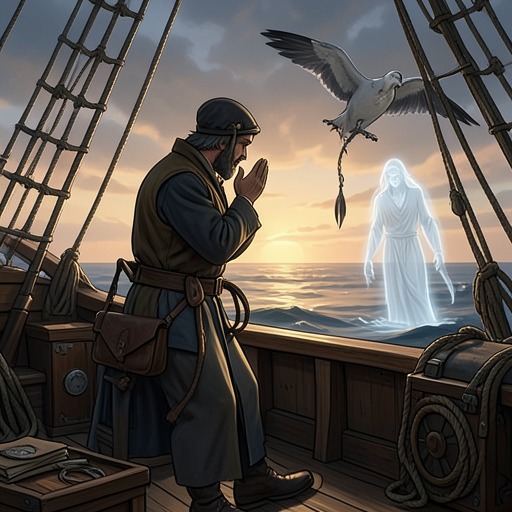
Ancient Mariner and the Albatross
The Rime of the Ancient MarinerThe relationship between the Ancient Mariner and the Albatross is the poem’s central passage from welcome to violence and from violence to penitential recognition. The bird appears through fog after a ship has been driven into polar ice; when a south wind rises and the vessel moves on, the Albatross follows. The Ancient Mariner later kills it with a crossbow, an act he recognizes as evil and consequential for the crew. The bird’s death becomes a visible burden around his neck, while his eventual blessing of other creatures restores his ability to pray and releases that burden. Their relationship gives concrete shape to the poem’s movement from casual participation in the living world, through guilt and isolation, toward reverence for life.
Arrival and Shared Passage
The Albatross enters when the ship is surrounded by fog and ice. It crosses the fog as if it were a Christian soul, a comparison that presents its arrival as more than an ordinary sighting. The ship has been driven into a threatening polar environment; the bird’s appearance precedes the ice splitting and the helmsman steering the vessel through. A good south wind then springs up behind the ship, and the Albatross follows it. The sequence binds the bird to the ship’s escape without claiming that the poem gives it a deliberate rescue plan: its presence accompanies the opening of a route out of the ice and the return of favorable wind.
The ship’s relation to the bird is initially hospitable. The Albatross follows day after day, coming for food or play, while the crew welcomes it and the Ancient Mariner observes it. This repeated companionship contrasts with the bird’s sudden killing. The Albatross is not introduced as an enemy or threat; it belongs to the daily life that resumes after the ship’s passage through the ice. Its closeness to the sailors makes the Mariner’s later violence a rupture within an established relation, rather than a response to danger.
The Killing and Its Consequences
The Ancient Mariner kills the Albatross with his crossbow. When the Wedding-Guest sees his appearance and asks about it, the Mariner answers by naming the deed as hellish and saying that it would bring the others woe. He confirms that the sailors all held him responsible for killing the bird. His account makes the act both personal and communal: it is his weapon and decision, but its consequences spread through the ship’s company.
The crew’s response gives the killing an immediate moral history. At first, the sailors condemn the Ancient Mariner for what he has done. Later, when the fog has cleared and the sun appears, they say that the bird’s killing was right, since it had brought the fog and mist. Their change of judgment does not undo the act; it shows the crew trying to interpret the bird through the shifting conditions of the voyage. The Albatross’s arrival had accompanied escape from the ice, yet the sailors temporarily treat its death as justified by the weather. The Ancient Mariner remains bound to the act even as the group’s verdict changes.
That bond becomes literal when the crew hangs the dead Albatross around the Ancient Mariner’s neck in place of the cross. The gesture turns the bird from a living companion into an imposed sign of guilt, and sets the Mariner’s deed against the religious symbol it displaces. The bird’s body is made to accompany him as a continuing accusation. The relationship therefore persists after the Albatross’s death: the creature is absent as a living presence but materially attached to the person who killed it.
Guilt, Prayer, and Release
The Ancient Mariner’s suffering is not limited to the crew’s blame or the weight around his neck. He looks toward Heaven and tries to pray, but before a prayer can emerge, a wicked whisper comes. The failed prayer marks an inward consequence of the killing: he cannot simply acknowledge the deed and move past it. The dead Albatross remains bound to a wider condition of guilt and spiritual estrangement, and the Mariner’s effort to pray is blocked.
The change begins not with a formal apology to the bird but with an unplanned response to other living creatures. The Ancient Mariner watches water-snakes coil and swim, their tracks flashing like golden fire, and recognizes their beauty as something no tongue can declare. Love wells up in his heart; he blesses them unaware. In that moment, he can pray again. The contrast with the crossbow is decisive: the earlier act was a deliberate killing, while the blessing comes spontaneously from attention and affection toward life.
At the same moment that prayer returns, the Albatross falls from the Ancient Mariner’s neck and sinks into the sea. The sequence makes the release inseparable from his changed relation to living things. The bird is not restored to life, and the text does not erase the killing; instead, the burden associated with it is removed after the Mariner has experienced a genuine movement of love. The Albatross’s fall marks a turn in his condition, not the end of his responsibility or story.
A Relationship Recast as a Lesson
The Albatross’s role in the relationship shifts through distinct stages: it arrives amid peril, accompanies the ship after it escapes the ice, is killed by the Ancient Mariner, and becomes the sign of his guilt. Its release from his neck follows his blessing of the water-snakes, extending the significance of the bird’s death beyond punishment alone. The poem connects the Mariner’s ability to pray with a change in how he responds to creatures other than himself; the Albatross’s story is thus joined to a larger lesson about the relation between love and spiritual life.
The Ancient Mariner later tells the Wedding-Guest that prayer belongs with love for humans and for birds and beasts, and that the best prayer belongs to those who love best. This closing teaching recalls the Albatross without reducing it to a simple emblem: the bird was first a living companion, then the victim of an unjustified killing, and finally the visible weight of an unresolved deed. The Mariner’s bond with it remains a lasting measure of his transformation. He learns to speak of reverence for all creatures only after he has seen the cost of treating one of them as disposable.